When AI Handles Support, Are You Measuring Customers or the Bot?
Imagine a monthly support review where the AI slide is the strongest slide in the deck. Containment is at an all-time high. Automation rate is climbing. First response time is measured in seconds instead of minutes. And in that same month, complaint volume rose, the same customers kept returning with the same problems, and retention slipped a little. Nobody in the room is misrepresenting anything. The dashboard is answering a different question than the one the business believes it is asking.
That gap is what this article is about. When AI handles a growing share of support, most dashboards keep reporting on the bot: how many conversations it closed, how fast it replied, how rarely it needed a human. Those are real numbers. On their own, though, they describe the system rather than the customer.
If your support runs across WhatsApp, Instagram, web chat and email, the measurement problem gets harder before it gets easier, because a conversation marked as resolved on one channel can quietly continue on another. Most teams start by putting every channel in one place, which is what a unified inbox such as Supsis live support is for. Measurement comes second, and it is the harder half.
The dashboard is reporting on the bot, not the customer
Containment is usually defined as a conversation the AI handled without escalating to a human. Look at that wording again. It describes an event inside your system. It does not say the customer's problem is gone. It does not say the customer stopped trying. It says a human did not get involved.
Those aren't the same claim, and the difference is where most AI support programs lose their footing. A conversation can be contained and still fail in at least five ways: the customer gives up, the customer rephrases the same question four times, the customer asks for a human and is talked out of it, the customer comes back tomorrow with the same issue, or the customer finishes on web chat and continues on WhatsApp.
None of those outcomes appear in a containment number. All of them appear in the customer's experience of your brand.
Activity metrics are not wrong, they are just not outcomes
The metrics most AI support dashboards lead with are useful for operating the system. As evidence that customers are being helped, they're weak. It's worth being precise about what each one actually measures.
- Containment rate measures how often the AI ended a conversation without a human. It's a routing and escalation metric. It says nothing about whether the answer was correct, complete, or accepted.
- Deflection rate measures how often a customer did not reach a human, sometimes including customers who left. A deflection can be a success or an abandonment, and the metric cannot tell you which.
- Automation rate measures the share of volume the AI touched. It rewards coverage, not quality. A bot that answers everything badly will beat a bot that answers a narrow set of questions well.
- First response time measures how quickly the first message went out. In an AI flow that number approaches zero by design, which makes it a poor proxy for how long the customer waited to be helped.
- AI-handled volume measures throughput. Volume is an input to cost, not an output for the customer.
None of these should be deleted. They belong on the operations dashboard, next to queue depth and staffing. They should not be the numbers you present as customer experience.
False resolution: the failure a single-channel dashboard cannot see
A false resolution is a conversation your system counts as closed while the customer's issue is still open. That isn't a bug in the bot. It's a gap between what you measure and what the customer experienced. Five signals show up repeatedly.
Abandonment. The customer stops replying mid-flow. The system closes the conversation on inactivity and records a resolution. In reality the customer left, possibly for a competitor.
Rephrasing loops. The customer asks the same thing in different words three or four times. Each turn looks like engagement. Together they are a signal that the bot is not understanding the intent.
Human requests that get deflected. The customer asks for a person, the bot offers one more self-service option, and the customer gives up. The escalation never happened, so the conversation counts as contained.
Repeat contact. The same customer returns with the same issue within a day or a week. This is the single most honest signal you have, and it is the one most often missing from AI dashboards.
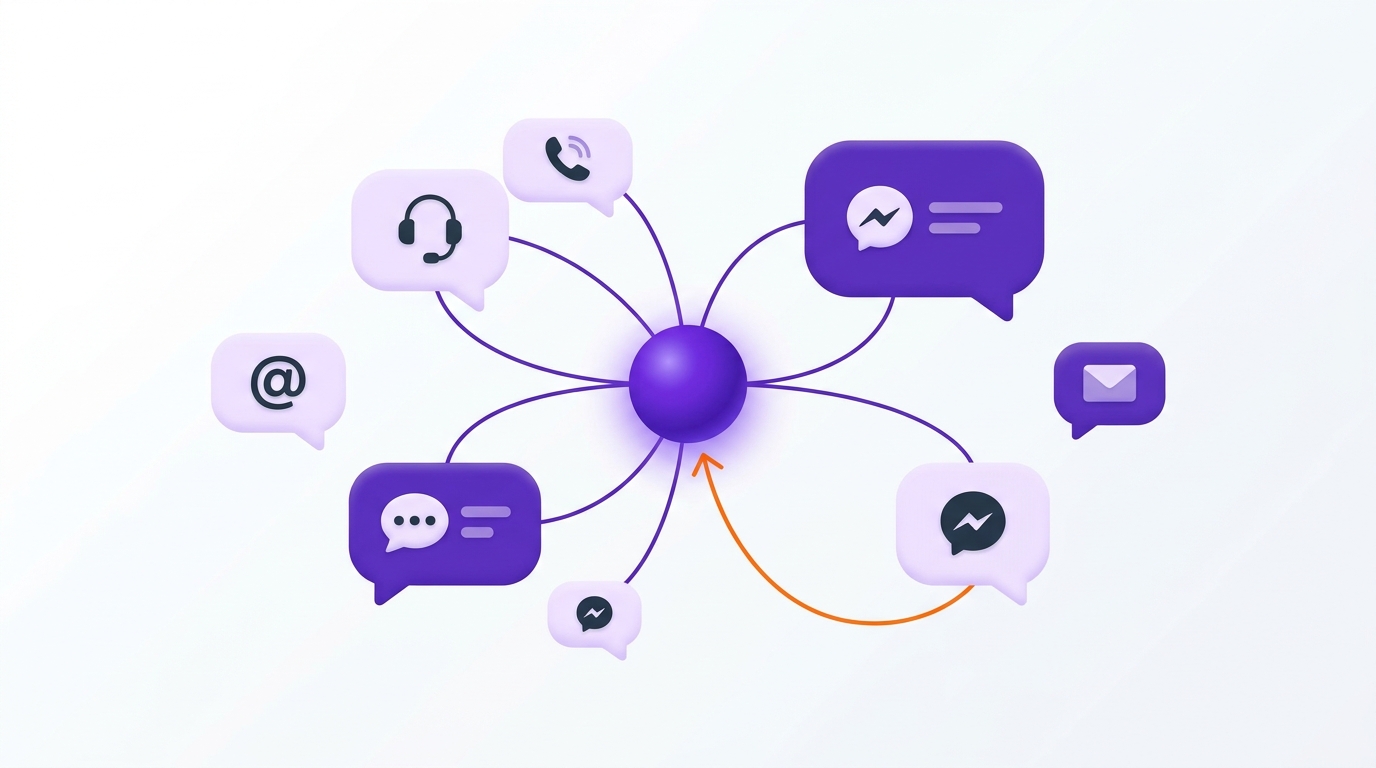
Channel switching. The customer finishes on web chat, then messages on WhatsApp, then calls. Each channel records its own outcome. Nobody records the journey.
The Resolution Reality Check: a five-layer framework
The framework below is deliberately plain to implement and hard to game. It moves from what happened in the conversation to what happened to the customer, and finally to what happened to the business. Call it the Resolution Reality Check. Each layer needs a stated denominator and a stated cohort, because a metric without a denominator is an opinion.
Layer 1 — Real resolution
Define real resolution as: no same-issue contact from the same customer within 24 hours and within 7 days, across all channels. The denominator is conversations the AI closed as resolved, not all conversations. The 24-hour window catches immediate failures; the 7-day window catches the ones that came back after the customer tried the advice.
Be honest about matching limits. Most teams do not have a clean issue identifier, so matching relies on customer identity plus intent plus a time window, and it will produce both false positives and false negatives. Disclose the method next to the number. A disclosed approximation is more useful than a precise-looking metric nobody trusts.
Layer 2 — Customer effort
Effort is what the customer had to spend to get an answer. Measure it as observable behavior first: number of messages to resolution, number of rephrasing attempts, number of explicit human requests, and time from first message to actual resolution. Add survey input if you have it, but treat a customer effort score as a supplement, not the foundation. Response rates on post-conversation surveys are low and skewed, and asking customers to rate every AI conversation trains them to ignore the request.
Layer 3 — Handoff quality

A handoff isn't a failure. A handoff that makes the customer repeat themselves is. Measure two things: whether the context arrived with the escalation, and whether the customer had to restate information they had already given. A practical indicator is the share of escalated conversations where the human agent asks for an order number, account detail, or problem description that already exists in the transcript.
Layer 4 — Business outcome
Where the interaction can be connected to a commercial event, connect it. Conversion after a sales conversation, order completion after a support conversation, and retention or churn signals for the affected cohort are the outcomes that justify the program. Don't force this layer where the data cannot support it. A support conversation about a delivery delay rarely has a clean conversion event, and pretending otherwise produces confident nonsense.
Layer 5 — Cost per resolved conversation
Cost per conversation rewards volume. Cost per resolved conversation rewards outcomes. The second number is the one that belongs in a budget conversation, because it is the only one that goes up when the bot gets worse at its job.

Why unnecessary bot turns are not free
Every additional turn in an AI flow has a cost, and on some channels that cost is literal. Meta's official WhatsApp Business Platform documentation states that per-message pricing replaced conversation-based pricing effective July 1, 2025, and that charges are based on delivered messages. Rates vary by market and by message category, and the rules have changed more than once, so check the current pricing page before you build a model on it. Do not assume every message is chargeable; the point is narrower and more useful than that.
The point is this: a flow that takes six clarifying turns where two would do is spending money to arrive at the same answer, and if the customer leaves without a resolution, you paid for the loop and got nothing back. That is the argument for cost per resolved conversation. It prices the loop, the abandonment and the repeat contact into a single number that a finance team can act on.
Omnichannel: the resolution that reappears on another channel
Here is a pattern that single-channel reporting cannot see. A customer asks about a refund on web chat. The AI explains the policy, the customer says thanks, the conversation closes as resolved. Two hours later the same customer messages on WhatsApp asking where the refund is. The next morning they call.
Three channels, three records, one unresolved issue. If your reporting is organized by channel, you will conclude that web chat performs well and that phone volume is a staffing problem.
Fixing this is mostly identity work, not AI work. You need a customer-level identity that survives channel changes, an issue grouping that survives rephrasing, a time window that is long enough to catch the return, and event stitching that puts the web chat, the WhatsApp message and the call into one timeline. Start with the identifiers you already have: phone number, email, customer ID, order number. Then measure how many customers have more than one open conversation in a 7-day window. That single query usually changes the roadmap.
A 30/60/90-day rollout
Don't change targets in month one. You don't yet know what normal looks like, and a target set before a baseline is a guess with a deadline attached.
Days 1–30: establish baselines
Pick five to eight intents that carry most of your AI volume. For each, record containment, same-issue repeat contact at 24 hours and 7 days, messages to resolution, human request rate, and handoff context completeness. Publish the definitions before the numbers, so nobody argues about the method after seeing the result.
Days 31–60: instrument the gaps
Add the measurements you are missing: cross-channel identity matching, post-handoff repetition, and cost per resolved conversation. Run a weekly review of a sample of transcripts from the highest-volume intents, read them as a customer would, and log every case where the system recorded a resolution and the customer did not get one.
Days 61–90: change targets and cadence
Only now move the targets, and move them per intent and per channel rather than as a single company-wide number. Segment every review by channel, intent, customer segment and AI flow, because an average across those dimensions hides exactly the failures you are looking for.
Reading the signals
The combinations matter more than the individual numbers. A few patterns worth memorizing.
- High containment with high repeat contact. The bot is ending conversations, not solving them. Look for knowledge gaps on the top contained intents and for escalation rules that make a human hard to reach.
- High AI resolution with high human repeat contact. The AI closes the loop but the customer does not accept the answer. Check answer quality and add a confirmation step before closing.
- Low response time with high effort. Fast and confusing. Shorten flows, remove unnecessary fields, and cut the rephrasing loops.
- High handoff rate with repeated context. Context is not travelling with the escalation. Pass the transcript, the customer identity and the detected intent, then measure how often the agent re-asks.
- High message volume with low resolution. The bot is generating turns rather than answers. Consolidate answers, cap the number of turns, and route to a human earlier.
Where Supsis fits
Supsis runs WhatsApp, Instagram, Facebook, Telegram, email and web chat in a single panel, with an AI chatbot and live support side by side, automation for the repetitive steps, a customer profile and history that follow the person across channels, reporting, and handoff to a live representative. That structure is what makes cross-channel measurement possible in the first place: if the channels are separate systems, the repeat contact you are trying to count is invisible by construction.
A word on what Supsis reports out of the box. The panel tracks average response time, agent ratings, call volume, proactive invitations and working hours, and the customer card keeps contact details, location and website visit history in one place. That covers the operational half of this framework. Repeat contact and cost per resolved conversation are still yours to define and build on top of it.
If you are evaluating the stack, the Supsis chatbot page covers the AI side, automation covers the repetitive work around it, and live support covers the handoff.
The uncomfortable conclusion
Your AI dashboard is probably not lying. It is answering a question about the bot, and you have been reading the answer as if it were about the customer. The fix is not a better dashboard. It is a different definition of success: a conversation counts when the customer's issue is gone, not when the system closed the ticket.
Start with one number. Same-issue repeat contact within 7 days, across all channels, for the intents your AI handles most. If that number is not moving in the right direction, nothing else on the slide matters.
Explore Supsis and see how a single panel for every channel changes what you are able to measure.
FAQ
What is a good AI containment rate?
There is no universal good number, and any article that gives you one without a source is guessing. Containment depends on your intent mix, your product complexity, your escalation policy and your channel. The useful question is not whether 70 percent is good, but what your containment is on a given intent and what the repeat contact rate is on the same intent. High containment with high repeat contact is worse than lower containment with real resolutions.
How do you measure repeat contact across channels?
Match on customer identity first (phone, email, customer ID), then on intent, then on a time window. Count a repeat when the same customer contacts you about the same issue within 24 hours and again within 7 days, regardless of channel. Disclose your matching method and its error rate next to the number, because identity matching is never perfect.
Is CSAT still useful with AI support?
Yes, as a supplement. CSAT tells you how the customer felt about the interaction they had. It does not tell you whether the issue was resolved, and low response rates skew the sample toward the very happy and the very angry. Use it alongside behavioral signals such as repeat contact and effort, not instead of them.
What is the difference between deflection and resolution?
Deflection means the customer did not reach a human. Resolution means the customer's issue is gone. A deflection can be a resolution, an abandonment, or a delay. Only repeat contact data can tell you which one you got.
What is cost per resolved conversation?
Total cost of the channel, the tooling and the human time, divided by the number of conversations that actually resolved the customer's issue. It is harder to calculate than cost per conversation and much better to manage against, because it goes up when automation produces loops instead of answers.
Which AI customer service metrics should be reviewed weekly?
Same-issue repeat contact at 24 hours and 7 days, messages to resolution, human request rate, handoff context completeness, and cost per resolved conversation. Containment and response time belong in the same review, but as context rather than as the headline.