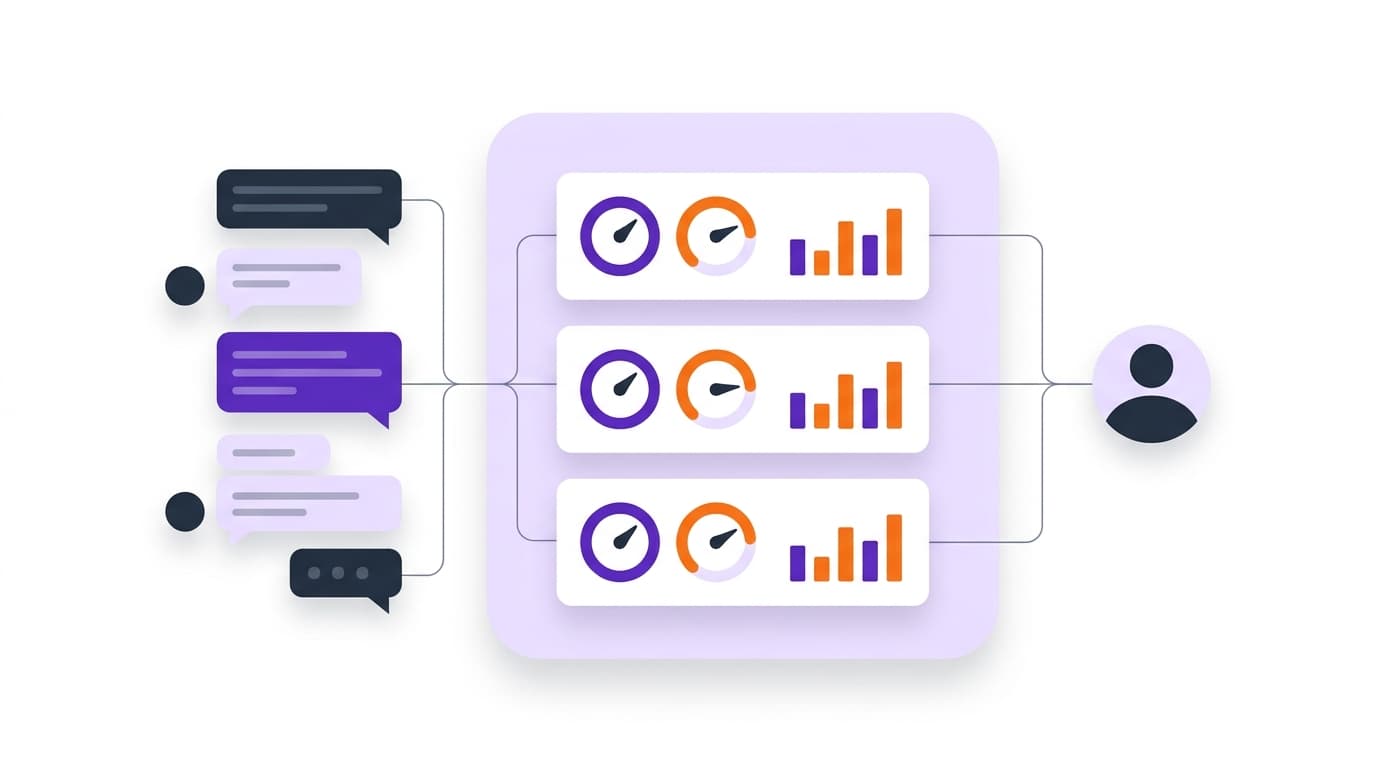
Quality Assurance in AI Customer Service: A Practical Guide to Conversation Analytics, Evaluation and Human Oversight
AI is no longer a side project in customer service; it is part of the daily operation. That shifts the question from "should we use a bot?" to "how do we measure the quality of what the bot produces?" A chatbot or an AI voice agent can close hundreds of conversations cleanly and still give wrong information, trigger the wrong action, or keep a customer waiting in circles in a handful of them. Quality assurance exists to make exactly those conversations visible.
This guide walks through a quality assurance system you can actually run: which outcomes to measure, which conversations to sample, how to write the rubric, how to combine automated scoring with human review, and how to run a 30-day pilot.
Start with three separate outcomes
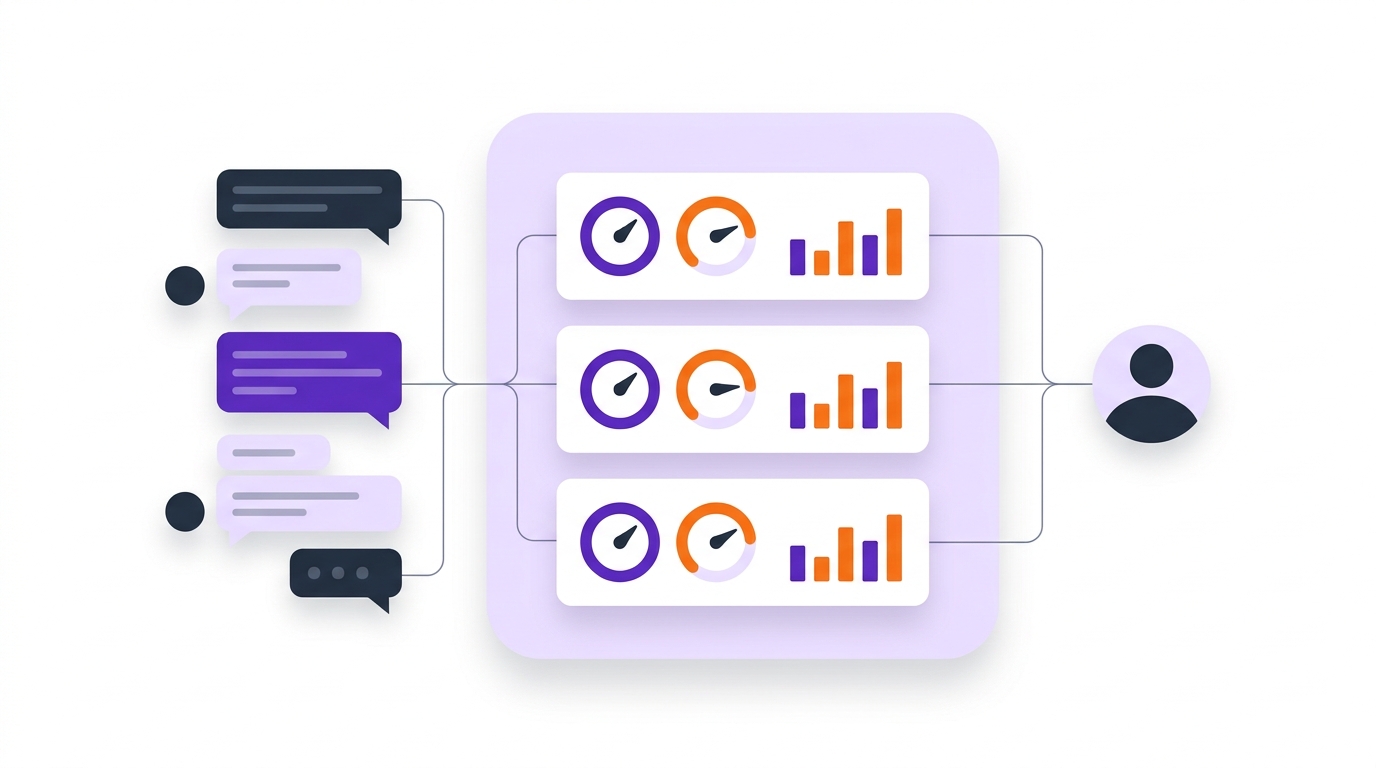
Reducing quality assurance to a single KPI is the most common mistake in this work. A healthy framework tracks three outcomes separately:
- Customer outcome: Did the customer get a resolution, did they have to come back, how much effort did they spend, were they satisfied?
- Operational outcome: How long did the conversation take, was it resolved on first contact, how many times was it transferred, how much load did it put on the team?
- Risk outcome: Was incorrect information given, was policy breached, was sensitive data shared more widely than necessary, was an irreversible action started?
These three axes do not substitute for each other. A high resolution rate can hide a high error rate, and a low error rate can make a bot that never actually helps look good. Showing them as separate cards prevents the wrong interpretation from day one.
Scope and sampling: read the right conversations, not all of them
Reading every conversation with a human does not scale, and relying only on automated scores creates blind spots. The practical answer is layered sampling.
Build your sample across these dimensions:
- Channel: WhatsApp, Instagram, web chat, email and voice calls should not share one rubric; tone and interruption matter on voice, clarity and guidance matter in writing.
- Intent: Order status, refunds, billing, technical support and complaints carry different risk.
- Risk level: Conversations involving payments, account changes and sensitive data get a separate, denser sample.
- Agent type: Bot-only, bot with human handoff, and human-only conversations belong in separate groups; otherwise bot performance blends into human performance.
- Language and segment: Accuracy can differ across languages and customer segments.
Split the sample in two: a random baseline sample that shows the overall trend, and rule-based critical cases such as low-confidence closures, repeat contacts, escalated conversations and detected negative sentiment. Read every critical case; keep the baseline sample at a fixed weekly number.
The rubric: separable criteria, not one score
The rubric is the backbone of quality assurance. A good rubric breaks "a good conversation" into measurable parts and describes each part at the level of observable behaviour. These criteria are a solid starting point for customer service:
- Accuracy: Is the information consistent with the source? Are there errors in factual areas such as price, lead time, stock or policy?
- Policy and knowledge base compliance: Does the answer contradict defined business rules or the approved knowledge base? Was something invented outside the knowledge base?
- Completeness: Was the whole question answered, or only the first part of it?
- Tone and language: Does the style match the brand, avoid talking down to the customer, and stay reasonably concise?
- Tool and data use: Was order, account or record data pulled from the right system? Was unnecessary data requested?
- Resolution: Was the customer's actual task solved, or did the conversation end with "I've forwarded this"?
- First contact resolution (FCR): Did the same issue come back within a short window?
- Handoff quality: Did the transfer carry a summary, history and completed actions? Did the customer have to repeat themselves?
- Security and compliance: Was identity verified, was sensitive data masked, was an unauthorised action blocked?
Score each criterion on a 1–5 scale and write one sentence for what each score means. For accuracy, 5 might be "fully consistent with the source", 3 "minor gap but not misleading", and 1 "an error that misleads the customer". An undefined scale produces disagreement between reviewers.
Add a critical error list to the rubric: reporting a wrong amount, starting an unauthorised refund, or sharing another customer's data should mark the conversation as failed regardless of the average score. Averages must not hide critical errors.
Evaluation flow: automated pre-score, human decision
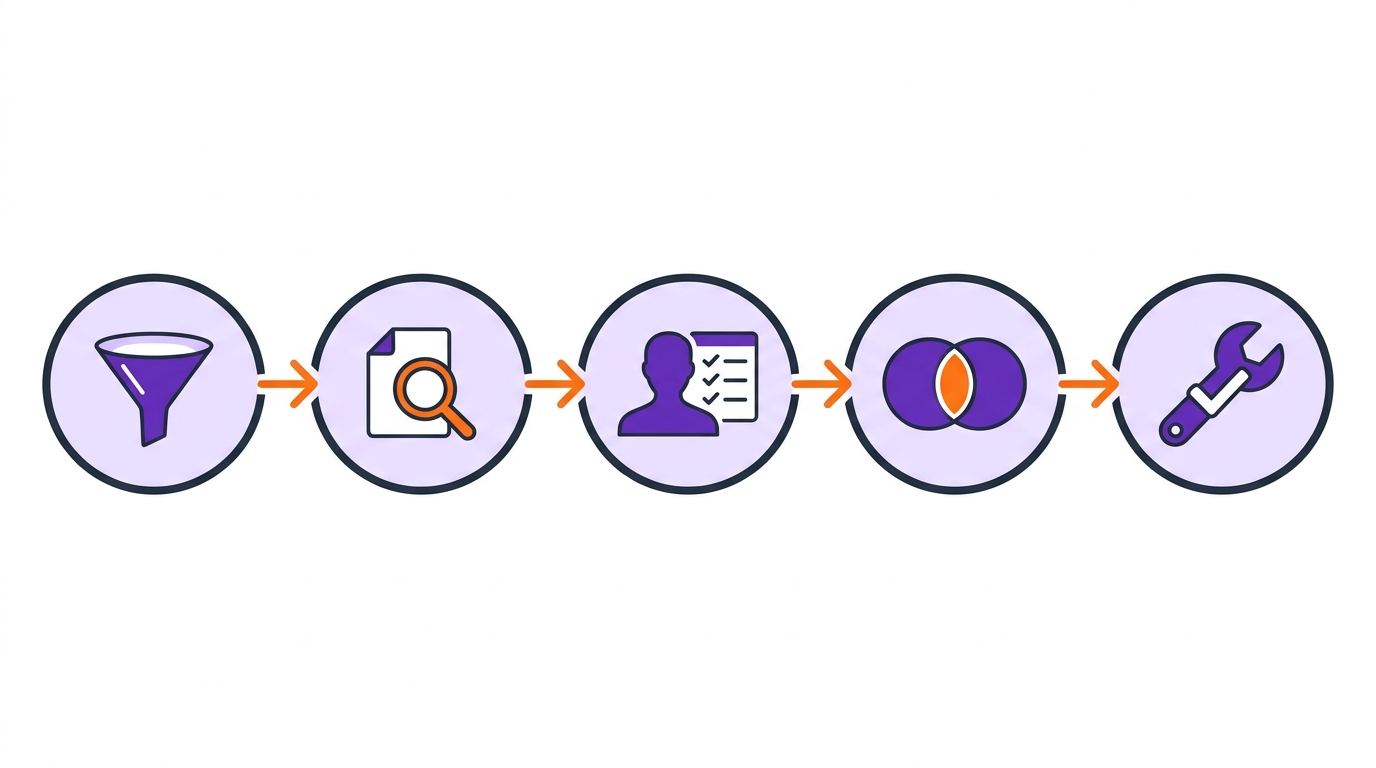
Conversation analytics is a strong tool for scanning volume, but it should not be the final judge on its own. A three-layer flow works well:
- Automated pre-evaluation: Intent, sentiment, key phrases, policy breach signals and rubric criteria produce a pre-score from the transcript. This layer scans every conversation and flags the risky ones.
- Human review: The sample and the flagged conversations are scored against the rubric by a quality specialist. If the specialist scores without seeing the automated result, you get a blind evaluation and can measure real drift.
- Dispute and calibration: Differences between automated and human scores are reviewed weekly. If the gap is systematic, the rubric, knowledge base or analysis model is updated; for individual cases, a reviewer note is recorded.
The most valuable output of this flow is not the score but the gap itself. If automation consistently scores high and humans consistently score low, either the analysis is too optimistic or the rubric is too strict. Both are fixable signals.
On Supsis, chatbot conversations, live chat conversations and voice agent calls can sit in the same panel, which makes sampling and comparison much easier. Supsis chatbot can be configured to learn from your own knowledge sources and hands complex requests to a live agent with the conversation history, which makes handoff quality measurable as its own criterion.
Handoff and approval layers: don't leave quality to chance
The most critical quality decision is where the bot stops. Handoff rules should be written down and embedded in the bot's flow. Three thresholds do most of the work:
- Confidence threshold: If the model's confidence in an answer falls below a set level, the bot hands off instead of guessing.
- Topic threshold: Payments, refunds, account changes, address updates, legal threats, health and safety issues go straight to a human.
- Sentiment threshold: Repeat contact, negative sentiment or rising tone routes the conversation to a human with priority.
At the handoff moment, tell the customer what is happening and when they will hear back, rather than a vague "I'll check and get back to you". On the human side, the summary, what the customer already explained and what the bot did should be ready. Otherwise the handoff becomes the moment quality drops.
For irreversible actions, add a separate approval layer: the bot prepares the action and a human approves it. This keeps speed while preventing a wrong refund or a wrong account change. On Supsis, live chat runs in the same panel, so the agent who takes over already has the history in front of them: Supsis live support. Voice needs the same structure; the AI voice agent supports this oversight with call recording and transcription, call analytics and human transfer.
Dashboard: few metrics, correctly split
A quality dashboard does not need to be crowded. These metrics are enough to see all three outcome axes:
- Resolution rate and first contact resolution (FCR)
- CSAT and repeat contact rate
- Average response time, resolution time and share of conversations closed within SLA
- Human handoff and escalation rate
- Count of wrong actions and policy breaches
- Breakdown by channel, intent and segment
Show metrics split, not as one total. An overall resolution rate of 80 percent can be 40 percent for refund intents, and that difference changes the operational decision entirely. Keeping quality records in dynamic tables makes conversation-level scores and corrective actions easy to track in one place: Supsis tables.
The weekly quality loop
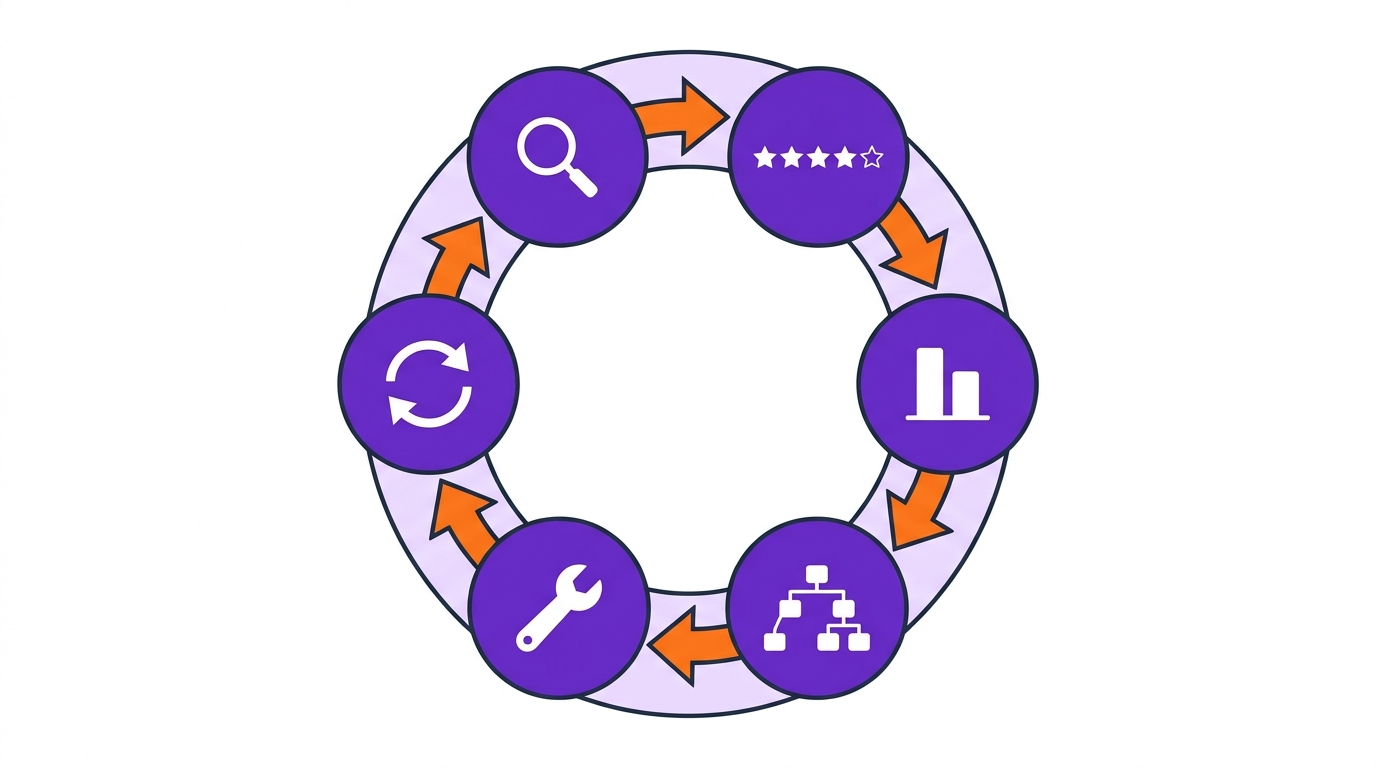
Quality assurance is a loop, not a one-time setup. Put the weekly rhythm into six steps:
- Sample: Pick the random baseline and the critical cases.
- Score: Apply the rubric, ideally blind.
- Compare: Put automated and human scores side by side.
- Find the root cause: Is the error a knowledge gap, a flow design issue, or a model interpretation problem?
- Fix: Update the knowledge base, the flow, the prompt or the handoff threshold.
- Run a regression test: Check that the fix did not break behaviour that used to be correct.
This fits comfortably into a 45–60 minute meeting. What matters is that the meeting is about fixing, not about reading scores. Every week should produce at least one concrete change.
Data governance: protect privacy while measuring quality
Quality work is one of the most data-intensive areas in customer service, so the measurement system should be designed with privacy rules from the start:
- Mask card numbers and identity numbers on evaluation screens.
- Keep only the excerpt needed for evaluation in quality records; if full transcripts are stored, define a retention period.
- Make access role-based so quality specialists, operations managers and developers see different scopes.
- Do not copy customer data into evaluation notes; use a record reference instead.
- Run call recording and transcription in line with applicable regulation and your company policy.
A 30-day pilot plan
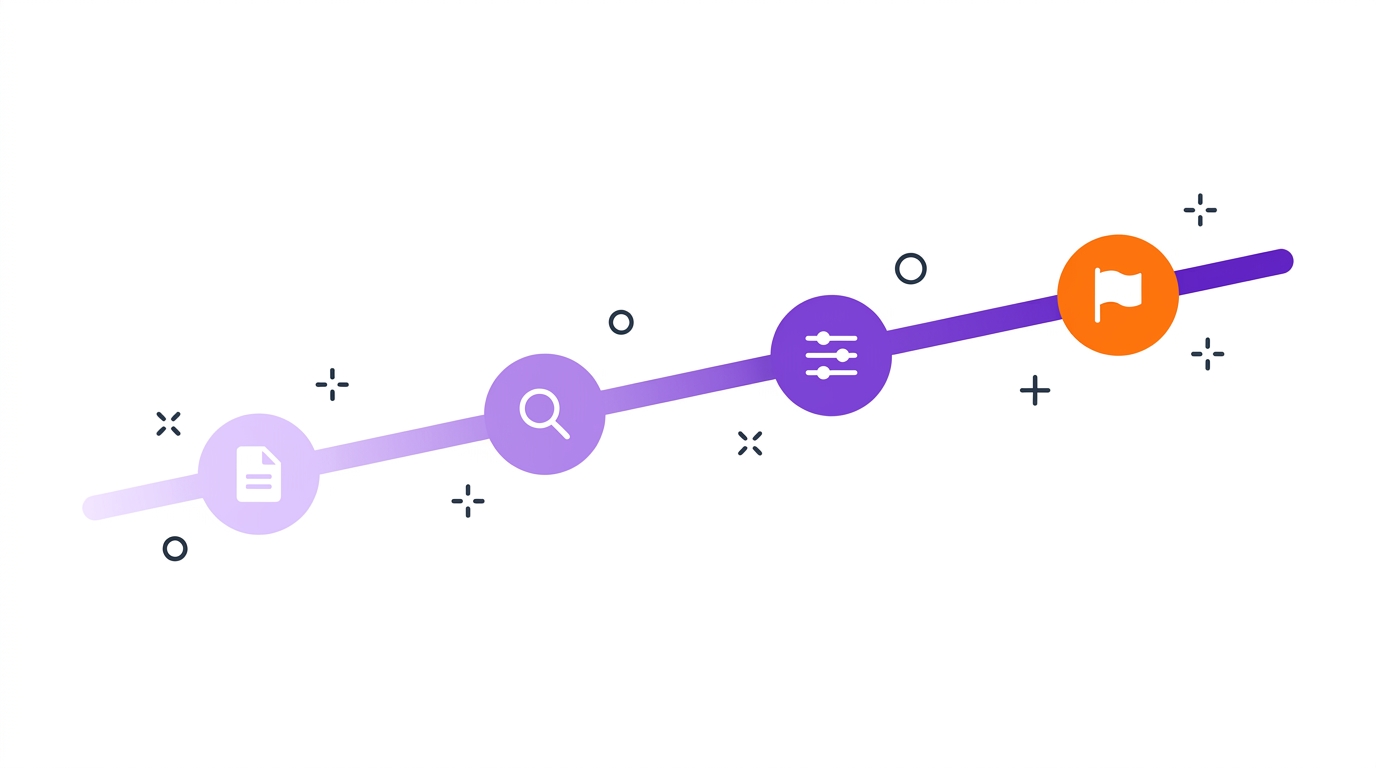
Before rolling quality assurance across the operation, pilot it on one channel or one intent group.
Week 1 — Rubric and baseline. Write the criteria, define the scale, and take a baseline measurement of 30–50 conversations. This is a reference point, not a verdict.
Week 2 — Sampling and automated pre-scoring. Apply the sampling rules, generate pre-scores with automated analysis, and test the critical error list.
Week 3 — Calibration and fixes. Compare human and automated scores, identify the three most common error types, and make the first fixes in the knowledge base and flow.
Week 4 — Comparison and decision. Compare results by channel and segment, update the rubric, thresholds and handoff rules, and make the rollout decision on that data.
The output of the pilot should be a working system rather than a report: an updated rubric, defined handoff thresholds, a weekly meeting on the calendar, and a named owner for measurement.
Conclusion
Quality assurance in AI customer service is not about policing the bot. It is about making the outcome visible and correctable. With the right rubric, layered sampling, a combination of automated analysis and human judgement, and a weekly correction loop, AI becomes both more reliable and more efficient. The important thing is to answer one question clearly from day one: which outcome am I measuring, and who fixes it?
To bring your customer conversations into one panel and start measuring quality, explore Supsis.